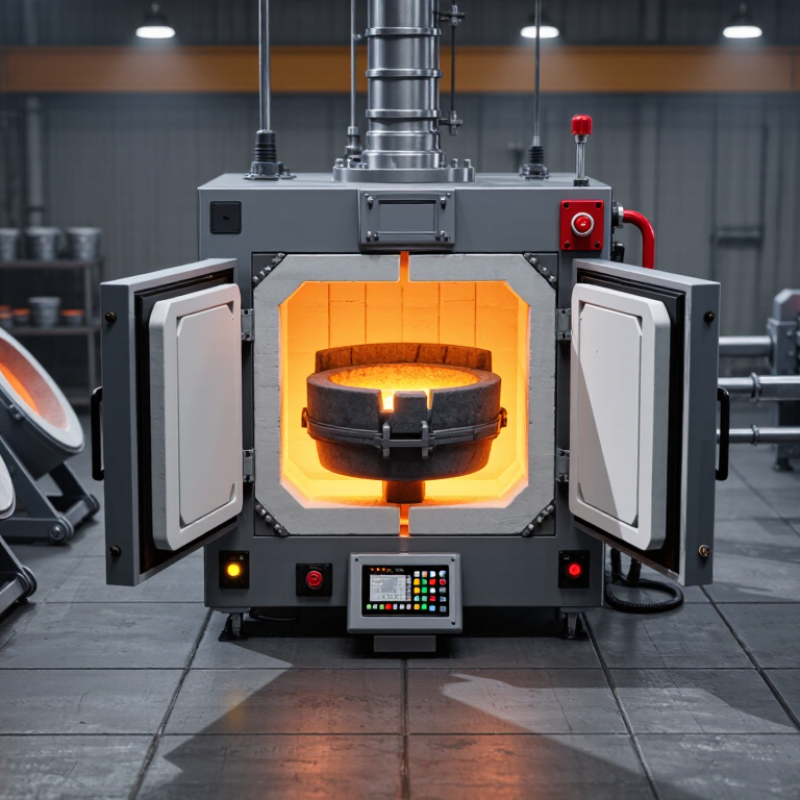
| Electric Resistance Melting Furnace | Electric resistance heating elements transfer heat through the chamber and crucible. | Approximately 50–1,000 kg per batch | Usually 700–800°C for aluminium melting; higher design temperatures may be available. | Approximately 1.5–4 hours, depending on charge size, alloy, and starting temperature. | Clean operation
Stable temperature control
Suitable for smaller and medium production volumes
Straightforward installation | Laboratories, maintenance shops, die-casting lines, small foundries, and plants with lower to medium melt demand. | Electrical power availability, element life, insulation quality, crucible material, and temperature-control accuracy. |
| Gas-Fired Crucible Furnace | Natural gas or liquefied petroleum gas burns around a removable or fixed crucible. | Approximately 100–1,500 kg per batch | Normally controlled around 700–850°C for aluminium alloys. | Approximately 1–3 hours, depending on burner output and charge preparation. | Fast heating
Flexible fuel options
Suitable for intermittent production
Lower dependence on high-capacity electrical service | General-purpose foundries, metal-recycling operations, job shops, and areas with economical gas supply. | Fuel cost, ventilation, combustion safety, burner control, refractory durability, and local emissions requirements. |
| Gas-Fired Reverberatory Furnace | Burners heat the roof and walls; radiant heat is reflected onto the aluminium bath. | Approximately 500–10,000 kg or more per batch | Typically 700–850°C, with separate control for melting and holding zones. | Approximately 1–4 hours, based on furnace size, burner capacity, and charge density. | Large batch capacity
Suitable for continuous or semi-continuous operation
Can accept a broad range of charge materials | High-volume casting, aluminium recycling, secondary aluminium production, and large foundries. | Floor space, fuel consumption, oxidation and dross generation, bath depth, refractory design, and charging system. |
| Induction Melting Furnace | An electromagnetic field induces current in the metal, producing internal heating. | Approximately 50–2,000 kg per batch for common foundry configurations | Usually operated near 700–850°C for aluminium, with precise set-point control. | Approximately 30–120 minutes, depending on power density and charge condition. | Rapid melting
Good temperature uniformity
No direct combustion gases
Accurate process control | Foundries requiring flexible alloy changes, controlled melting, high productivity, or reduced direct combustion exposure. | Electrical infrastructure, power-factor equipment, coil and lining maintenance, electromagnetic stirring, and operator training. |
| Electric Resistance Holding Furnace | Electric heating elements maintain molten aluminium in an insulated holding chamber. | Approximately 100–2,000 kg holding capacity | Commonly maintained around 680–760°C, according to alloy and casting process. | Not primarily designed for rapid melting; holding and temperature recovery are the main functions. | Stable holding temperature
Reduced heat loss during casting
Well suited to automated transfer or dosing | Die casting, low-pressure casting, gravity casting, and production lines requiring a continuous molten-metal supply. | Insulation performance, temperature uniformity, automatic level control, transfer method, and compatibility with the casting machine. |
| Electric Tilting Crucible Furnace | Electric resistance elements heat a crucible that tilts hydraulically or mechanically for controlled pouring. | Approximately 100–1,000 kg per batch | Typically 700–850°C, depending on alloy and pouring requirements. | Approximately 1–3 hours, depending on rated power and charge size. | Controlled pouring
Reduced manual ladling
Good batch flexibility
Suitable for clean, repeatable casting operations | Gravity casting, sand casting, permanent-mould casting, and operations needing safer or more consistent metal transfer. | Tilting mechanism reliability, pouring angle, crucible replacement, load distribution, control-system integration, and safety interlocks. |
| Electric Tower or Shaft Melting Furnace | Preheated aluminium charge is fed through a vertical shaft into a melting and holding zone. | Approximately 500–5,000 kg/h melting output | Melting and holding zones are commonly controlled within approximately 700–850°C. | Continuous operation; output depends on installed power, charge form, and thermal recovery. | Continuous production
Efficient use of preheated charge
Reduced manual charging
Suitable for integration with casting lines | Medium- and high-volume die-casting or casting plants requiring a steady supply of molten aluminium. | Charge preparation, feeding consistency, automatic controls, dross management, maintenance access, and line-layout requirements. |