How to Choose the Right Coffee Packaging Bags?
Choosing the right Coffe Packaging Bags begins with protecting freshness, not simply selecting an attractive print. Roasted coffee quickly loses quality when exposed to oxygen, moisture, heat, or light. The bag must therefore match the coffee format, roast profile, filling process, and distribution distance.
Industry data shows why this decision matters. The International Coffee Organization reported global coffee consumption at approximately 177.9 million 60-kilogram bags in 2023/24. That scale increases pressure on packaging performance, consistency, and responsible material use. Grand View Research also identifies flexible packaging as a major segment within the global coffee packaging market. However, market estimates differ between reports. That difference deserves attention.
A practical starting point is barrier performance. A dark-roasted coffee shipped across humid regions may need high oxygen and moisture resistance. A freshly roasted specialty coffee may also require a one-way degassing valve. Kraft paper can improve shelf appearance, but its inner barrier layer carries the real protection. Small details matter. Seal width matters. Valve placement matters. Filling temperature matters.
William Ristenpart, director of the Coffee Center at the University of California, Davis, has emphasized that coffee quality depends on controlling the environment around the beans. His widely used teaching principle is: “Coffee is a complex material.” That idea applies directly to packaging choices. No single bag works everywhere.
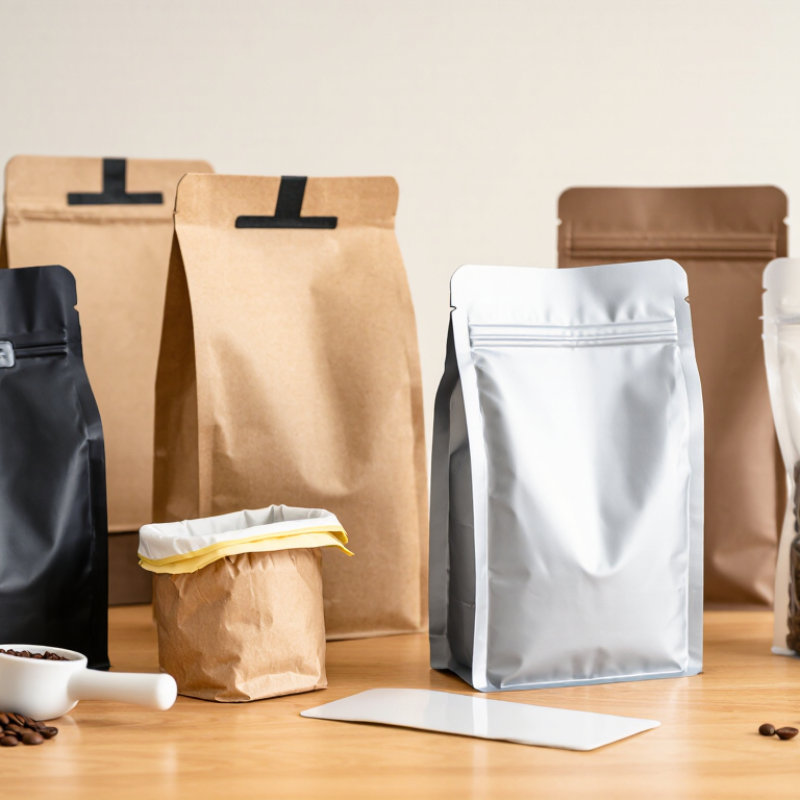
This guide will compare valve bags, flat-bottom bags, quad-seal designs, recyclable structures, and traditional multilayer formats. It will also examine cost, shelf life, branding, and end-of-life considerations. Some choices remain imperfect. Better packaging is not always the most sustainable packaging. The right decision requires evidence, testing, and honest trade-offs.
Define Freshness Goals for 6–12 Months of Coffee Shelf Life
How to Choose the Right Coffee Packaging Bags?
Define Freshness Goals for 6–12 Months of Coffee Shelf Life
Coffee packaging should begin with a clear freshness target. Six months is different from twelve months. Roasted coffee gradually loses aroma, releases carbon dioxide, and absorbs surrounding odors. A suitable bag must slow oxygen, moisture, and light exposure. I have seen attractive packaging fail because its inner barrier was too weak. Appearance cannot replace performance.
For a six-month shelf life, set measurable limits for oxygen transmission and moisture vapor transmission. Choose a strong barrier structure with reliable heat seals. For twelve months, demand tighter specifications and more storage testing. A one-way valve can release excess gas after roasting. However, it does not repair poor sealing or excessive oxygen inside the package. Fill coffee after it cools properly, then remove unnecessary headspace where practical.
Test real production samples, not only laboratory films. Store sealed bags under expected warehouse conditions, including warm periods and humidity changes. Check aroma, flavor, seal strength, and package swelling at scheduled intervals. Keep lot records. Small differences matter.
Do not overtrust a single test.
A packaging engineer or qualified laboratory can verify barrier data, seal integrity, and aging results. Yet results may change with roast level, grind size, filling speed, and handling. My own early trials focused too much on film thickness and missed weak corner seals. That mistake showed why packaging selection needs repeated checks, not one confident decision.
How to Choose the Right Coffee Packaging Bags?
Define freshness goals for 6–12 months of coffee shelf life by comparing typical oxygen transmission rates (OTR). Lower OTR means stronger protection against oxygen-driven aroma loss and oxidation.
Key takeaway: For a 6–12 month freshness target, high-barrier metallized or aluminum-foil laminates are generally more suitable than uncoated or standard plastic structures. The values shown are representative OTR benchmarks at 23°C and 0% relative humidity; actual performance depends on laminate construction, seals, valves, filling conditions, and storage environment.
Match Bag Size to Common 250 g, 500 g, and 1 kg Fill Formats
Choosing the right coffee packaging bag starts with the fill format, not the artwork. CBI’s 2024 European coffee market guidance identifies 250 g, 500 g, and 1 kg as common retail pack sizes. These formats match different buying habits and handling needs. A 250 g pouch suits trial purchases and freshly roasted coffee. A 500 g bag supports regular home use. A 1 kg format works better for cafés, offices, and high-consumption households.
For 250 g, choose a compact stand-up or flat-bottom pouch with enough headspace for roasted beans. A 500 g bag usually needs a wider body and stronger side seals. For 1 kg, a gusseted or flat-bottom structure improves shelf stability. The actual dimensions depend on bean density, roast level, valve placement, and filling equipment. Do not size the bag by weight alone. The National Coffee Association’s Spring 2024 report found that 67% of American adults drank coffee during the past day, showing strong demand for convenient household formats. Still, convenience is not just a bigger opening.
Test every size with real beans. Fill, seal, stack, and drop the sample. A neat bag can still collapse on a retail shelf. My first sizing assumption would probably be too tight. Leave practical space for degassing, sealing, and easy handling, then adjust after production trials. Flexible packaging guidance from the Sustainable Packaging Coalition also stresses that material selection and package design should be evaluated together, rather than separately.
Specify OTR <1 cc/m²/day and WVTR <1 g/m²/day for High Barriers
Choosing the Right Coffee Packaging Bags
Fresh coffee reacts quickly with oxygen and moisture. Oxygen can dull aroma, weaken flavor, and accelerate staling. Moisture may soften roasted beans and damage their crisp texture. For high-barrier coffee bags, specify an oxygen transmission rate (OTR) below 1 cc/m²/day and a water vapor transmission rate (WVTR) below 1 g/m²/day.
These values should be tested under clearly stated conditions. Temperature and relative humidity can change the results significantly. Ask for laboratory reports using recognized methods, such as ASTM D3985 for oxygen transmission and ASTM F1249 for water vapor transmission. The bag film may meet the target, yet the finished package can fail at its seals, folds, zipper, or valve. Inspect those areas carefully. A tiny channel in a heat seal can quietly shorten shelf life.
In practical packaging trials, I would fill sample bags with freshly roasted coffee, seal them on the actual production equipment, and store them under expected warehouse conditions. Then I would check aroma, bag pressure, seal strength, and coffee quality over time. The valve also deserves attention because it can influence gas exchange. A test certificate is useful, but it is not the whole answer. I have seen promising materials perform poorly after careless sealing. Cost, recyclability, and machine compatibility also matter, although chasing the cheapest bag can become an expensive mistake.
How to Choose the Right Coffee Packaging Bags? — Specify OTR <1 cc/m²/day and WVTR <1 g/m²/day for High Barriers | Packaging Structure | Typical OTR
(cc/m²/day) | Typical WVTR
(g/m²/day) | Barrier Performance | Best Use for Coffee | Key Advantages | Main Limitations | Meets High-Barrier Target? |
| PET / Aluminum Foil / PE | <0.01 | <0.01 | Very high oxygen, moisture, light, and aroma protection | Premium whole-bean coffee, ground coffee, and long shelf-life products | Excellent protection against oxidation, humidity, light, and flavor loss | Not transparent; aluminum layer can be damaged by folding or sharp creases; difficult to recycle as a mixed laminate | Yes — Excellent |
| PET / Metallized PET / PE | 0.05–0.5 | 0.05–0.3 | High oxygen, moisture, and light barrier | Roasted coffee requiring strong protection with a metallic appearance | Strong barrier-to-cost balance; good printability; lower material weight than foil structures | Barrier can decrease if the metallized layer is scratched, folded, or poorly laminated | Yes — High |
| PET / PE with EVOH Barrier Layer | 0.1–1.0 | 0.3–1.0 | High oxygen barrier; moisture barrier depends on the PE layer and construction | Coffee packaging where recyclability goals and oxygen protection are both important | Good oxygen barrier; can support mono-material or reduced-material designs | EVOH oxygen performance may decline at high relative humidity; requires suitable layer thickness and quality control | Usually — Verify |
| BOPP / Metallized BOPP / CPP | 0.2–1.0 | 0.1–0.6 | High moisture and light barrier with moderate-to-high oxygen barrier | Short-to-medium shelf-life roasted coffee and high-speed form-fill-seal applications | Good moisture resistance; attractive surface appearance; efficient machine processing | Actual oxygen barrier varies significantly with metallization quality, coating, and sealing conditions | Potentially — Test |
| PET / PE | 50–150 | 2–6 | Moderate moisture protection but limited oxygen and aroma protection | Short shelf-life coffee, secondary packaging, or products with additional protective packaging | Cost-effective; durable; widely available; suitable for standard printing and sealing | Usually insufficient for extended roasted-coffee freshness; does not meet the high-barrier specification | No |
| Paper / PE | 100–300+ | 2–8 | Low oxygen barrier and limited moisture protection | Outer bags, short-term packaging, or applications where appearance is more important than long shelf life | Natural paper appearance; good print surface; suitable for branding and tactile presentation | Paper alone is not a reliable high-barrier layer; odor, oxygen, and moisture can pass through the package | No |
| Mono-PE High-Barrier Film | 0.5–5.0 | 0.2–1.5 | Variable barrier depending on coatings, additives, and film thickness | Recyclability-focused coffee packaging with moderate shelf-life requirements | Potentially easier to recycle within compatible PE systems; flexible and lightweight | Not every mono-PE structure achieves OTR below 1; barrier coating and package design must be validated | Sometimes — Confirm by Test |
| Specification guidance: For high-barrier roasted-coffee bags, request an oxygen transmission rate (OTR) below 1 cc/m²/day and a water vapor transmission rate (WVTR) below 1 g/m²/day. Values are indicative ranges for finished film structures and can vary with thickness, relative humidity, temperature, coating quality, lamination, seals, valves, and testing methods. Confirm the complete package under the intended test conditions, and evaluate the one-way degassing valve and zipper separately because package components can become the main leakage path. |
Verify Seals and Materials Through 6–12-Month Shelf-Life Testing
How to Choose the Right Coffee Packaging Bags?
A coffee bag should protect aroma long after filling day. Laboratory results help, but real shelf-life testing reveals weaknesses that short trials miss. Test several production lots, not only one carefully selected sample. Small differences in sealing pressure can change performance.
Store sealed bags for 6–12 months under defined temperature and humidity conditions. Record oxygen exposure, moisture transfer, seal strength, and package appearance at set intervals. Examine pinholes, delamination, wrinkles, and valve behavior. Test both unopened bags and bags opened repeatedly during normal use. Coffee also releases gas after roasting, so internal pressure deserves attention.
Use practical controls. Keep some samples in stable warehouse conditions, and expose others to warmer, more humid environments. Measure aroma, flavor, staleness, and moisture alongside instrument data. A bag may pass a seal test yet produce flat coffee by month six. That result matters. Material selection should match roast level, grind size, expected distribution, and filling process.
Our first testing plan was too neat. It ignored rushed sealing during busy production periods. That was a mistake. Retesting under realistic conditions gave more useful evidence. Document every failure, including minor creases and uneven seals. Reliable packaging decisions come from repeated measurements, trained sensory review, and honest comparison between early results and later performance.


