3D Barrier Bags, Inc

Top 10 Warehouse Barcode Labels for Global Buyers

Choosing the right Warehouse Barcode Labels can determine whether a global warehouse moves smoothly or loses hours to scanning errors. Label stock, adhesive strength, barcode symbology, print contrast, and data accuracy all matter. A label that works perfectly on a clean carton may fail on a chilled pallet, a dusty rack, or a curved plastic container. Small details become expensive problems.

Bob Carpenter, former President and CEO of GS1 US, has emphasized, “The barcode is a gateway to trusted product data.” That principle remains practical for international buyers. A reliable label should support clear identification, consistent scanning, and traceable inventory information across suppliers, carriers, and distribution centers. This article reviews ten Warehouse Barcode Labels suited to different warehouse conditions, including thermal transfer labels, direct thermal labels, durable polyester options, freezer-grade labels, and high-visibility rack labels.

The “best” label is not universal. It depends on storage temperature, handling pressure, scanner distance, surface texture, and expected service life. Buyers should test samples before placing large orders. It sounds obvious. It is often skipped.

Even experienced teams make imperfect assumptions. A stronger adhesive may improve carton performance but complicate label removal. A sharper print may still fail when the wrong barcode size is selected. By comparing material quality, print durability, application performance, and supplier support, global buyers can make a more dependable decision. The goal is not simply a readable barcode. It is a label that remains readable when warehouse conditions become less than ideal.

Top 10 Warehouse Barcode Labels for Global Buyers

Warehouse Barcode Label Types and Their Core Applications

Top 10 Warehouse Barcode Labels for Global Buyers

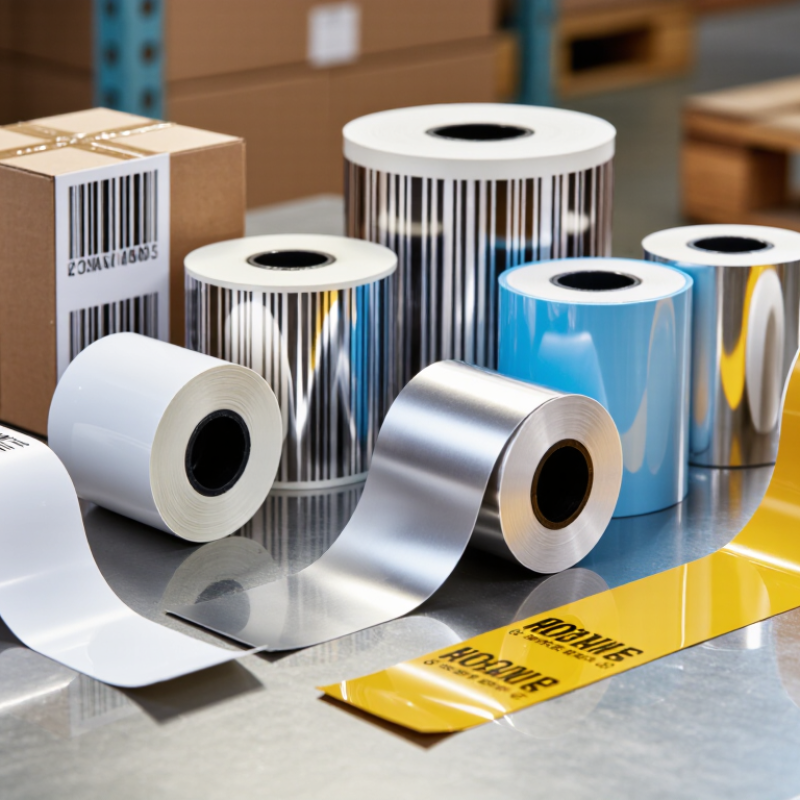
Warehouse barcode labels differ by material, data format, and operating environment. Direct thermal paper suits carton labels, cross-docking, and short-term dispatch. Thermal transfer paper performs better for inventory records stored for months. Synthetic polypropylene resists moisture and suits chilled rooms, bins, and returnable containers. Polyester handles abrasion, cleaning chemicals, and high-touch locations. Freezer-grade labels need adhesive tested below zero. Regular glue may fail quickly. High-temperature labels support manufacturing areas and heated storage zones. Reflective labels improve scanning on tall-rack locations, where lighting and distance create problems.

Serialized labels support traceability for pallets, cartons, and individual assets. GS1 standards recommend structured identifiers and data formats, including GS1-128 and two-dimensional symbols. These formats carry more information than simple retail codes. RFID-enabled labels can support faster bulk identification, although they require compatible readers and careful site testing. The 2024 MHI Annual Industry Report indicated that 46% of supply chain organizations already use robotics and automation, while 83% expect adoption within five years. Reliable labels become more important as manual checking declines.

Core application should guide material selection. A two-dimensional label may hold expiry data, but poor contrast still causes failures. A tough label is not automatically the best label. For global buyers, test adhesion, print darkness, scan distance, temperature, and surface dust before ordering. The 2024 Zebra Warehousing Vision Study also highlights growing pressure to improve warehouse visibility and accuracy. I would not rely on a sample scan alone. Real cartons, cold air, curved surfaces, and rushed operators reveal the weaknesses.

Material, Adhesive, and Durability Choices for Warehouse Labels

Top 10 Warehouse Barcode Labels for Global Buyers

Material, adhesive, and durability choices determine whether a warehouse label scans once or survives daily handling. A 2024 warehouse operations survey reported that 76% of decision-makers planned technology upgrades to improve inventory visibility. That goal starts with readable labels.

For the top ten label choices, compare synthetic polypropylene, polyester, and coated paper. Paper suits dry, indoor cartons and reduces cost. Polyester handles abrasion, moisture, and repeated forklift contact better. Polypropylene offers flexibility for curved containers. Thermal-transfer printing usually provides stronger long-term resistance than direct thermal printing, especially near heat or sunlight. Still, direct thermal labels remain practical for short-cycle shipping tasks.

Adhesive selection needs equal attention. Permanent adhesives suit fixed racks and bins. Removable adhesives help with reusable containers. Freezer-grade formulas must bond below freezing, not merely after warming. A 2023 cold-chain packaging report noted that temperature swings remain a major cause of label failure. That detail is easy to overlook.

Warehouse benchmark data from WERC’s 2024 DC Measures report placed median inventory accuracy near 99%. One unreadable label can still disrupt that performance. Test samples on dusty steel, corrugated cartons, plastic totes, and stretch film. Check scan distance, edge lifting, condensation, and abrasion after handling. My practical warning is simple: the most expensive label is not always the most durable. Over-specification wastes money, while cheap adhesive creates rework. Pilot testing remains imperfect, but it exposes failures before a full rollout.

Top 10 Warehouse Barcode Labels for Global Buyers

Comparative suitability ratings for common warehouse barcode label constructions. Scores from 1 to 5 reflect typical performance characteristics of the material, adhesive, and durability in warehouse applications.

Rating guide: 1 = limited suitability, 5 = excellent suitability. Synthetic materials generally provide better moisture, abrasion, and chemical resistance than standard paper, while permanent adhesives are preferred for long-term pallet, shelf, and bin identification.

Top 10 Warehouse Barcode Labels for Different Storage Environments

Global buyers need warehouse barcode labels that match real storage conditions, not just attractive specifications. The top ten options include paper, polypropylene, polyester, freezer-grade, chemical-resistant, outdoor UV-resistant, heat-resistant, dust-resistant, removable, and moisture-proof labels. Each material solves a different problem.

Paper suits dry indoor racks.
Polypropylene handles splashes and frequent handling.
Polyester performs better near loading bays, where sunlight and abrasion are common.

Cold rooms demand strong adhesive and flexible face stock. A label should remain readable on cartons below freezing. Condensation can expose weak materials quickly. High-temperature areas require thermal-stable labels that resist curling. Chemical storage needs protective coatings and tested adhesive resistance.

Dusty warehouses benefit from bold contrast, sealed surfaces, and barcode sizes that scanners can read from practical distances. In warehouse trials, Code 128 often works well for cartons, while two-dimensional codes carry more data in limited space. Yet placement still matters. A perfect label can fail when folded over an edge.

Tips: Test labels in the actual environment for at least one operating cycle. Check moisture, freezer exposure, friction, and scanner distance. Leave clear space around each barcode. Do not rely on adhesive claims alone.

Sample testing is slower, but cheaper than relabeling thousands of cartons. I once underestimated condensation. That mistake was avoidable. Also confirm print darkness, surface cleanliness, and core size before ordering. Small details often decide whether inventory moves smoothly or pauses.

Barcode Standards, Printing Methods, and Scanning Requirements

Top 10 Warehouse Barcode Labels for Global Buyers

Barcode standards decide whether a label works beyond one warehouse. GS1-128 supports logistics data, including shipment and pallet identifiers. ITF-14 remains useful for corrugated cases and outer packaging. Code 128 fits compact carton labels. DataMatrix and QR codes can carry more information in smaller spaces. GS1’s General Specifications require consistent structure, placement, and data quality. These details matter during cross-border receiving.

Printing method affects durability and scan speed. Direct thermal printing suits short-term labels, but heat and sunlight can darken its surface. Thermal transfer printing offers stronger resistance against abrasion, moisture, and temperature changes. Choose resin or wax-resin ribbons after testing the actual packaging. A glossy label may look excellent. It can still reflect scanner light. In warehouse trials, poor contrast often creates more trouble than low resolution.

Scanning requirements should follow ISO/IEC 15415 for two-dimensional symbols and ISO/IEC 15416 for linear barcodes. The Zebra 2023 Warehousing Study reported that 58% of decision-makers planned fixed industrial scanning by 2028. The 2024 MHI Annual Industry Report also found that 74% of supply chain leaders planned to increase technology investment. Buyers should test labels at distance, angle, speed, and under damaged conditions. My practical concern is simple: laboratory grades can mislead. Dust, curved cartons, and rushed operators expose weaknesses quickly. A small quiet test is valuable.

How Global Buyers Compare Suppliers, Costs, and Customization Options

Global buyers compare warehouse barcode labels by total operating cost, not unit price alone. MHI’s 2024 Annual Industry Report shows that 67% of supply chain professionals expect artificial intelligence to affect operations within five years. That shift increases demand for reliable, machine-readable labels. A label that scans correctly on the first attempt can reduce picking delays, relabeling, and manual checks. Small details matter.

Supplier evaluation should cover material, adhesive, barcode grade, print method, and delivery consistency. GS1 recommends verifying barcode quality against ISO/IEC 15416 requirements, especially for logistics symbols used on corrugated cartons and plastic totes.

Buyers should request test samples on actual surfaces, including dusty cardboard, cold storage bins, and curved containers. One sample is not enough. Warehouse conditions change.

Cost comparisons also need a wider lens. Ask suppliers to separate label stock, printing, tooling, packaging, freight, and rejected quantities. Custom options may include variable data, serialized codes, color zones, tear resistance, and removable adhesives. However, excessive customization can create longer lead times and more inspection points.

A 2023 global warehousing study reported that 58% of warehouse decision-makers planned to deploy fixed industrial scanning by 2028. This makes contrast, placement, and consistent dimensions increasingly important. I would not trust the cheapest quote without a traceable quality record. Rechecking the assumptions is often worthwhile.